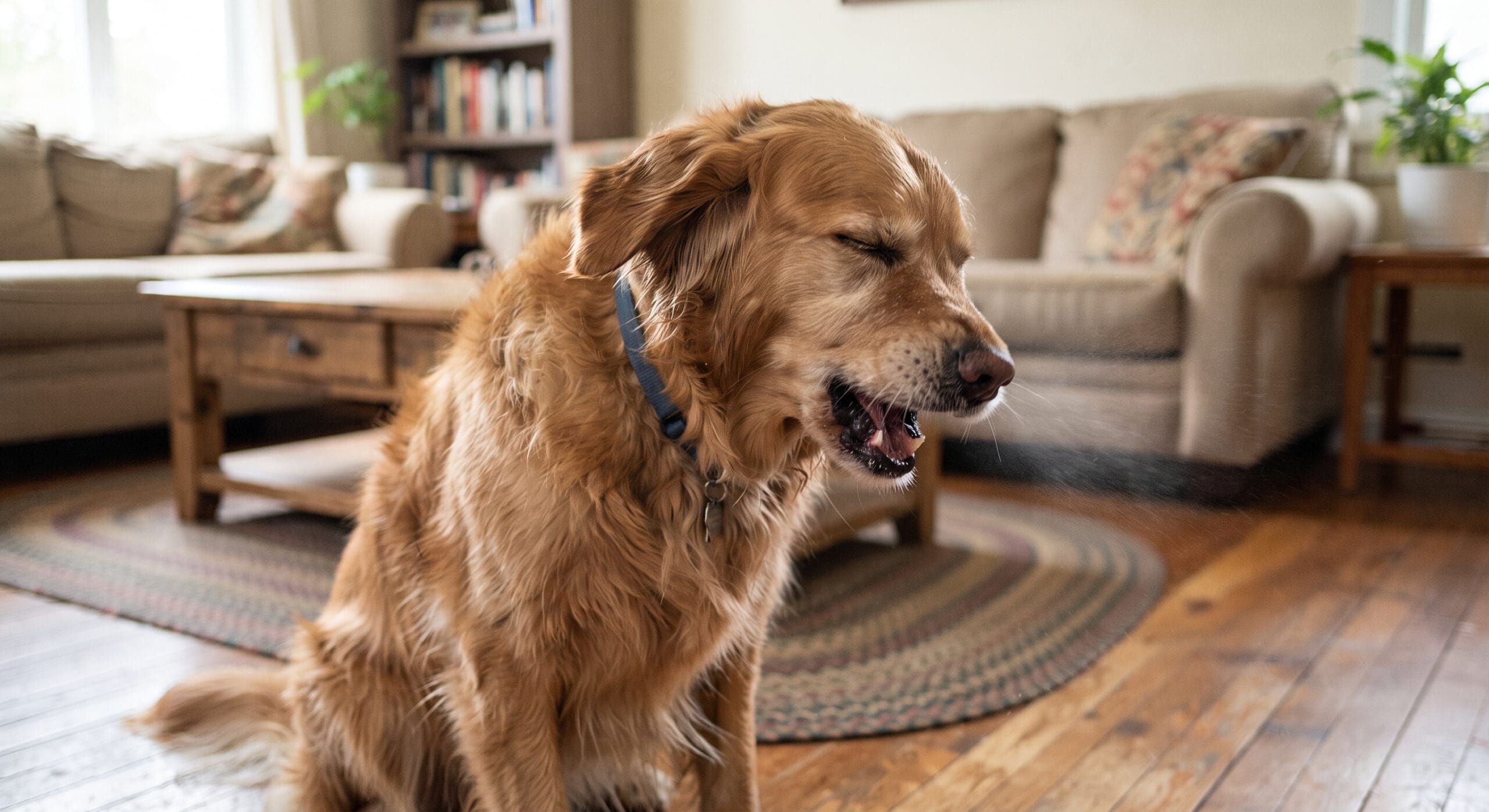
Your dog suddenly freezes, stretches out its neck, and starts making a loud, honking, snorting noise — like it’s trying to inhale a sneeze. Your first thought is probably is my dog choking? Take a breath: in almost every case, this is reverse sneezing in dogs, and it’s one of the most common — and most harmless — things a dog can do.
Here’s a real example of what it looks and sounds like, so you can compare it to what your dog is doing right now: watch a reverse sneezing episode on YouTube. If your dog looks and sounds like this, you’re almost certainly not looking at an emergency.
Below, our team at Boulevard Animal Hospital breaks down what’s actually happening, how to tell it apart from choking or a collapsed trachea, how to help your dog through it, and when it’s actually time to call us.
Reverse Sneezing vs. Choking: The Quick Answer
This is the question that matters most in the moment, so here it is up front:
| Reverse Sneezing | Choking | |
|---|---|---|
| Sound | Rapid, rhythmic snorting or honking | Often silent, or gagging/retching |
| Body language | Stands still, neck extended, elbows out | Paws at mouth/face, panics, may collapse |
| Gums | Normal pink color | Can turn pale, gray, or blue |
| Duration | Seconds to about a minute, then normal | Does not resolve on its own |
| What to do | Stay calm; it will pass | Emergency — check the mouth, call a vet immediately |
If your dog’s gums are turning blue or gray, if they seem genuinely panicked or are pawing frantically at their face, or if whatever is happening doesn’t stop within a minute or two, treat it as an emergency and call us or an emergency vet right away. But if your dog looks like the dog in the video above — snorting loudly but otherwise alert — you have time to keep reading.
What Is Reverse Sneezing, Exactly?
Reverse sneezing (the clinical term is paroxysmal respiration) is a reflex spasm of the throat and soft palate. A normal sneeze pushes air out through the nose to clear an irritant. A reverse sneeze does the opposite — your dog rapidly pulls air in through the nose, which is where the name comes from.
During an episode, dogs typically:
- Stop moving and plant their feet
- Extend their head and neck forward
- Make a loud snorting, honking, or gagging sound
- Look like they’re struggling, even though airflow is still moving
According to Cornell University’s Riney Canine Health Center, reverse sneezing is a common, generally benign reflex — not a disease in itself, but a response to irritation.
What Causes It
Reverse sneezing happens when something irritates the nasal passages, throat, or soft palate. Common triggers include:
- Environmental irritants — pollen, dust, mold, perfume, cleaning products, or smoke. If your dog also deals with seasonal symptoms, this is often the same irritant behind both — see our guide to pollen allergies in dogs for more on managing seasonal triggers.
- Excitement or overexertion — many dogs reverse sneeze after vigorous play
- Eating or drinking too fast
- Leash pressure on the throat, especially from a collar rather than a harness
- Nasal mites or a foreign object, like a blade of grass or seed, lodged in the nasal passage
- Anatomy — short-nosed breeds with elongated soft palates (Pugs, French Bulldogs, English Bulldogs, Boston Terriers, Boxers) and small breeds in general are more prone to it, a pattern also noted by the American Kennel Club
Reverse Sneezing vs. Collapsed Trachea
Choking gets ruled out fast, but this comparison takes a bit more attention because both conditions can sound similar over time.
Reverse sneezing is an isolated, self-limiting spasm — a rhythmic snorting inhale that stops within a minute, after which your dog goes right back to normal.
Tracheal collapse is a chronic, progressive condition caused by weakened cartilage in the windpipe. It shows up as a dry, harsh cough often described as a “goose honk” — a cough, not a snorting inhale — frequently triggered by excitement, drinking, or collar pressure, and it tends to recur and worsen over time rather than happening once and resolving. It’s most common in middle-aged and older small and toy breeds and does require veterinary management.
If your dog is having recurring “episodes” that are really more of a chronic cough than a snorting inhale, that’s worth a visit rather than a wait-and-see.
How to Help Your Dog During an Episode
Most episodes stop on their own within a minute, but you can help it along:
- Stay calm and speak softly — your dog is picking up on your energy
- Gently massage the throat in a downward motion to help ease the spasm
- Briefly cover both nostrils for a second or two, then release, to encourage swallowing
- Lightly blow on your dog’s face — this can also trigger a swallow reflex
- Offer a lick of water or a treat once it passes, to help clear any lingering irritation
Avoid restraining your dog tightly or reacting with alarm — dogs pick up on panic, and a calm response genuinely helps them settle faster.
When to Call Boulevard Animal Hospital
A single, brief episode in an otherwise healthy dog is rarely cause for concern. Call us if:
- Episodes are becoming more frequent or more intense
- Your dog also has nasal discharge, especially if it’s thick, colored, or bloody
- You notice bad breath, facial swelling, or pawing at the nose or face
- Your dog seems to have trouble breathing between episodes, not just during them
- You’re genuinely unsure whether what you saw was reverse sneezing, choking, or something else — a video clip on your phone (much like the one linked above) is one of the most useful things you can bring to an appointment
Chronic or worsening reverse sneezing can sometimes point to nasal mites, a lodged foreign object, dental disease affecting the nasal passages, or a mass — all things we can identify with a hands-on exam. If your dog has also been unusually lethargic or off their water, it’s worth a look at the signs covered in our dehydration in dogs post as well.
Frequently Asked Questions
Is reverse sneezing painful for dogs?
No. While it looks and sounds alarming, reverse sneezing is not painful, and most dogs return to normal activity immediately after an episode ends.
How can I tell reverse sneezing apart from choking?
Reverse sneezing is a rhythmic, repeated snorting sound while your dog stays alert and standing; choking is often more panicked, may be silent or accompanied by pawing at the mouth, and gums can turn pale or blue. If in doubt, treat it as an emergency.
Can cats have reverse sneezing too?
Yes, though it’s far less common in cats than in dogs. The same nasal and throat irritation can trigger it, and the same “does it stop on its own” guidance applies.
Why does my dog only reverse sneeze during certain seasons?
Seasonal reverse sneezing is usually a sign of environmental allergies — pollen, mold spores, or cut grass are common culprits.
Should I be worried if my puppy reverse sneezes?
Occasional reverse sneezing is normal at any age, including in puppies, and often becomes less frequent as the airway matures. Frequent or severe episodes are still worth a vet visit to rule out anatomical issues or a foreign object.
Can I prevent reverse sneezing episodes?
You can reduce frequency by switching to a harness instead of a collar, minimizing exposure to household and seasonal irritants, using a slow-feeder bowl if your dog eats quickly, and keeping up with routine nasal and dental checkups.
Dr. Jennifer Howard, DVM, sees dogs of all breeds and ages at Boulevard Animal Hospital in Athens, GA, and is happy to help you tell the difference between a harmless reverse sneeze and something that needs a closer look. Schedule an appointment if your dog’s episodes have you concerned.
“`